Gambling Addiction Statistics: Current U.S. Data (Updated 2026)

Updated July 2026. The newest national participation data in this article were collected in 2024. The most recent U.S. national probability survey we found with a diagnostic-style screen collected its data from 2011 to 2013.
The United States does not have one current national survey that can answer how many people have gambling disorder in 2026. Available estimates come from studies that use different questions, thresholds, time periods, and populations.
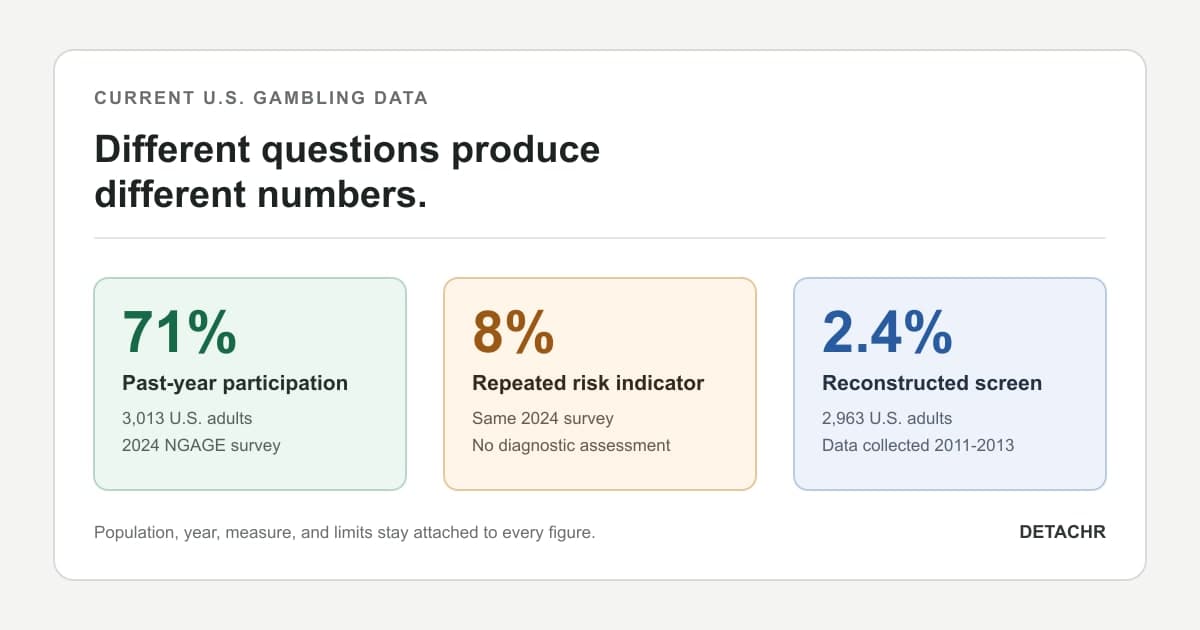
The clearest current national picture combines several sources. A 2024 U.S. survey found that 71% of adults had gambled during the previous year, while 8% reported at least one repeated risk indicator. That survey was designed to measure participation and risk signals, not to diagnose gambling disorder. A national probability survey collected in 2011 to 2013 found that 2.4% of adults met a reconstructed DSM-5 screening threshold. Older federal diagnostic-interview studies produced lower estimates.
Those numbers can all be accurate within their own methods. They answer different questions. This guide keeps the population, data year, measure, and main limitation next to each statistic so the differences stay visible.
This article is educational content. Detachr content is not clinically reviewed.
Key U.S. statistics and global context #
- 71% gambled during the previous year
- 3,013 U.S. adults, 2024. Participation in at least one included activity.
- Source and limits
- 8% reported a repeated risk indicator
- The same 2024 U.S. survey. Four possible harm signals, with no diagnostic assessment.
- Source and limits
- 23% made a sports bet; 22% wagered online
- The same 2024 U.S. survey. Self-reported participation.
- Source and limits
- 2.4% met a reconstructed DSM-5 threshold
- 2,963 U.S. adults, 2011 to 2013. Telephone screening with reconstructed criteria.
- Source and limits
- 0.27% met an older reconstructed DSM-5 threshold
- 43,093 U.S. adults, 2001 to 2002. Past-year federal household-interview data.
- Source and limits
- 58% of people ages 18 to 22 tried sports wagering
- 3,527 U.S. young adults, 2023. Broad online-panel participation measure.
- Source and limits
- 29.6% of facilities reported offering treatment
- 15,953 responding facilities included in 2024 federal tables. Service availability only.
- Source and limits
- 20.63% had sought help
- 705 participants in the PGSI problem-gambling category across 13 representative studies. Professional, informal, and self-help combined.
- Source and limits
- 4.8 diagnoses per 100,000 active adult patients
- Q1 2026 electronic health-record rate in states grouped as having legalized sports betting. This is a recorded-diagnosis rate, not population prevalence.
- Source and limits
- 1.41% was the pooled global problematic-gambling estimate
- 121 representative adult samples covering 43 countries and territories. Different instruments and thresholds; no U.S.-specific diagnosis rate.
- Source and limits
Every figure is explained below and linked to its source.
What counts as gambling addiction? #
Four types of numbers appear often in gambling statistics:
- Participation means someone gambled during a defined period.
- Risk indicators are behaviors associated with possible harm, such as repeatedly gambling more than planned.
- Problem gambling is usually a survey classification based on a screening scale and cutoff.
- Gambling disorder is a clinical diagnosis defined in the DSM-5-TR.
The terms cannot be swapped without changing the meaning of a statistic. A survey may find that many people have placed a bet while identifying a much smaller group with repeated harms or enough symptoms to cross a screening threshold.
Timeframe matters too. Past-year, lifetime, and current estimates use different denominators. A lifetime rate will usually be higher because it includes anyone who met the criteria at any point in their life.
U.S. gambling addiction estimates #
The most recent national probability survey we found with a diagnostic-style gambling screen collected data from 2011 to 2013. Welte and colleagues surveyed 2,963 U.S. adults by landline and mobile phone. They reported that 2.4% met a reconstructed DSM-5 threshold during the previous year.
That result came from a structured telephone screen rather than a clinician's diagnosis. The researchers reconstructed DSM-5 scoring by removing the illegal-acts criterion and lowering the threshold from five criteria to four. The survey's landline and mobile response rates were 54.0% and 62.7%.
Two older federal studies offer useful context:
- The National Comorbidity Survey Replication, using data collected in 2001 to 2003, estimated DSM-IV pathological gambling at 0.6% over a lifetime and 0.3% during the previous year.
- A reanalysis of the 2001 to 2002 National Epidemiologic Survey on Alcohol and Related Conditions estimated 0.27% for past-year gambling disorder under reconstructed DSM-5 rules.
The gap between 0.27% and 2.4% shows how much results can move when surveys use different interviews, recruitment methods, thresholds, and screening rules. None of these studies gives a precise 2026 count.
The National Council on Problem Gambling currently estimates that about 1% of U.S. adults experience a severe gambling problem and another 2% to 3% experience mild or moderate problems. These are NCPG planning estimates. They should not be described as results from a new federal DSM-5 survey.
Current U.S. participation and risk signals #
NCPG's NGAGE 3.0 report surveyed 3,013 adults across all 50 states and Washington, D.C., from January through March 2024.
It found:
- 71% had participated in at least one included gambling activity during the previous year;
- 23% had made a sports bet;
- 22% had wagered online;
- 8% reported at least one of four potentially problematic behaviors "many times" during the previous year.
The repeated risk-indicator figure was 15% among adults ages 18 to 34 and 2% among adults ages 55 and older. It was 17% among traditional sports bettors and 19% among online bettors.
NGAGE explicitly says it was not designed to estimate the prevalence of DSM-5 gambling disorder. Its short public report also provides limited detail about recruitment, weighting, response rates, and statistical uncertainty. The results are useful as a recent snapshot of behavior, with those limits attached.
Young adults and sports betting #
A 2023 NCAA online-panel survey included 3,527 people ages 18 to 22. It found that 58% had tried at least one broadly defined sports-wagering activity. The definition included bets with friends, fantasy sports, pools, and licensed or unlicensed platforms.
The same survey found that 16% met at least one behavior the researchers labeled risky. That category included frequent betting, a typical bet of at least $50, or ever losing more than $500 in a single day. The final measure was reported by 5.8%, rounded to 6% in the report.
These are participation and custom risk measures from an online panel. They do not show that 58% of young adults have a gambling addiction.
People who want to close sportsbook access can use the guide to quitting sports betting. It covers account closure, self-exclusion, live-betting triggers, game days, money barriers, and support.
Recorded diagnoses in health-system data #
A June 2026 Epic Research study examined electronic health records for more than 197 million U.S. adults with at least one qualifying healthcare encounter from January 2018 through March 2026.
Among active adult patients living in states grouped as having legalized sports betting, the quarterly rate of recorded gambling diagnoses rose from 3.0 per 100,000 in Q1 2018 to 4.8 per 100,000 in Q1 2026. The comparison group of states that had not legalized sports betting moved from 3.1 to 2.2 per 100,000.
This rate measures diagnoses recorded during healthcare encounters. It is not a population prevalence estimate. Gambling disorder is under-recognized in clinical care, coding practices can change, and healthcare use shifted during the study period. The authors also found that increases ran roughly in parallel across the legalized-state group instead of following each state's launch date. Their analysis cannot attribute the trend to a specific legalization event.
Online sportsbooks and help-seeking #
Legal online sports betting expanded rapidly after the 2018 U.S. Supreme Court decision that allowed states to authorize it. A 2025 study in JAMA Internal Medicine examined U.S. Google searches from January 2016 through June 2024.
The researchers estimated 23% more searches combining gambling terms with words such as addiction, addict, anonymous, or hotline than expected after the court decision. In separate analyses of New York and Pennsylvania, increases were larger after online sportsbooks opened than during the preceding retail-only periods.
Search activity can capture people who gamble, relatives, journalists, students, or general curiosity. It is a signal of information-seeking at the population level. It does not measure diagnoses or identify who made each search.
Financial harm #
Gambling does not normally appear as a line item on a credit report. Related missed payments, growing card balances, collections, and bankruptcy can affect credit. The gambling and credit-score guide explains those pathways and the limits of what credit reports show.
A peer-reviewed Journal of Financial Economics study, available online ahead of its September 2026 issue, used transaction data from 183,821 U.S. households across state online-sports-betting launches. The authors found that legalization reduced saving and investment and increased consumer debt, with larger effects among frequent bettors and households with low savings.
The study examines household financial behavior after legalization. It does not estimate gambling-disorder prevalence, and an average effect cannot predict the outcome for one household.
Mental health and suicide risk #
A 2024 systematic review and meta-analysis combined 107 studies involving people with gambling problems. Across the included community and clinical samples, the pooled lifetime prevalence was 31.6% for suicidal ideation (95% CI, 29.1% to 34.3%) and 13.2% for suicide attempts (95% CI, 11.3% to 15.5%).
The samples, definitions, countries, and study quality varied. The authors found evidence of bias and said the direction of causality remains unclear. These figures describe the groups included in the research. They do not mean that gambling alone caused every crisis.
If you may harm yourself or someone else, call or text 988 in the United States or 9-8-8 in Canada. Use local emergency services for immediate danger.
Treatment availability and help-seeking #
The 2024 National Substance Use and Mental Health Services Survey found that 4,730 of 15,953 responding substance-use treatment facilities included in the U.S., D.C., and territory tables, or 29.6%, reported offering treatment for gambling disorder. Participation was voluntary, and the published totals were not adjusted for facility nonresponse.
That result measures what facilities said they offered. It does not show how many people received treatment, whether a gambling specialist delivered it, or how effective the service was.
A 2022 systematic review and meta-analysis found that 20.63% of 705 participants in the PGSI problem-gambling category had sought help across 13 representative studies (95% CI, 12.89% to 31.35%). The definition included professional services, support from family or friends, and self-help. Measurement differed across studies, heterogeneity was high, and the authors found high risk of bias.
The National Problem Gambling Helpline logged 377,410 contacts in 2025, an average of about 31,451 per month. The total is incomplete because 1-800-GAMBLER call and text data were unavailable from October through December. Contacts can include repeat use and do not represent the general U.S. population.
Research also does not support one universal treatment success rate. Our gambling recovery statistics guide explains what randomized trials, follow-up periods, and natural-recovery studies can tell us.
Global context #
A 2024 Lancet Public Health systematic review and meta-analysis identified 380 representative adult and adolescent samples across 68 countries and territories. Its adult samples covered 43 countries and territories, representing about 41% of the global adult population. The review estimated that 46.2% of adults had gambled during the previous year and 8.7% experienced any level of risky gambling.
For problematic gambling, the pooled estimate was 1.41% (95% CI, 1.06% to 1.84%) across 121 representative adult samples with 958,273 participants. The review pooled different years, screening tools, products, and national settings. This global estimate does not provide a current U.S. gambling-disorder rate.
What the data cannot answer #
Current research cannot provide:
- one precise U.S. gambling-disorder rate for 2026;
- a personal diagnosis based on one population statistic;
- a causal explanation for every association with debt, mental health, or suicide;
- a universal recovery percentage or treatment timeline;
- a clean comparison between studies that use different screens and thresholds.
We did not multiply an older percentage by the 2026 U.S. population. That calculation would create a current-looking count without collecting current diagnostic data.
We also excluded treatment-center statistics pages, casino blogs, market-size forecasts, and search-volume estimates as prevalence sources.
Getting help #
Call or text the National Problem Gambling Helpline at 1-800-MY-RESET for free, confidential, 24/7 support and referrals in the United States.
Practical next steps can include:
- Use the help directory to find helplines, peer support, treatment directories, and crisis resources.
- Enroll in an official self-exclusion program that covers the products and operators you use.
- Add a gambling-blocker plan and remove saved account access.
- Ask your bank which controls from the gambling transaction-blocking guide it supports.
- Tell one trusted person what practical support would help today.
Sources and method #
- NCPG NGAGE 3.0 Key Findings, 2024 survey data.
- Welte JW, et al. Gambling and problem gambling in the United States: changes between 1999 and 2013. Journal of Gambling Studies.
- Kessler RC, et al. DSM-IV pathological gambling in the National Comorbidity Survey Replication. Psychological Medicine.
- Petry NM, et al. Past-year gambling disorder in the U.S. under DSM-IV and DSM-5. Psychology of Addictive Behaviors.
- NCAA: National survey of sports wagering among people ages 18 to 22, 2023.
- Epic Research: Recorded gambling diagnoses among active adult patients, 2018 to Q1 2026.
- Yeola P, et al. Sportsbook expansion and gambling-addiction help-seeking searches. JAMA Internal Medicine. 2025.
- Baker SR, et al. Gambling away stability. Journal of Financial Economics. 2026.
- Kristensen JH, et al. Suicidality among individuals with gambling problems. Psychological Bulletin. 2024.
- SAMHSA: 2024 N-SUMHSS Annual Report and Detailed Tables.
- Bijker R, et al. Global prevalence of help-seeking for problem gambling. Addiction. 2022.
- Tran LT, et al. The prevalence of gambling and problematic gambling. The Lancet Public Health. 2024.
- NCPG: Current U.S. problem-gambling planning estimates.
- NCPG: National Problem Gambling Helpline 2025 Annual Report.
- 988 Lifeline: U.S. crisis support.
- 9-8-8 Canada: Suicide Crisis Helpline.
We prioritized representative surveys, federal data, systematic reviews, meta-analyses, and official program reports. Each number was checked against its original source on July 24, 2026. See the Detachr editorial standards for our sourcing and corrections policy.
Related next steps
- Understand recovery statistics
See what treatment trials and natural-recovery studies can and cannot predict.
- Quit sports betting
Close sportsbook access and prepare for live betting, game days, losses, and major events.
- Find confidential help
Use official helplines, peer support, treatment directories, and crisis resources.

Detachr Editorial Team
Detachr's editorial team writes and updates practical gambling recovery content using official guidance and primary research where available. Our articles are educational and are not clinically reviewed or a substitute for professional advice.
Read our editorial standards →Take back control today
Detachr combines iMessage accountability, phone blocker support, urge tracking, and recovery tools in one flow.
Start in iMessageDisclaimer: This content is for informational purposes only and does not constitute medical, legal, or financial advice. If you are experiencing a gambling problem, please contact the National Problem Gambling Helpline at 1-800-MY-RESET or consult a qualified professional.